

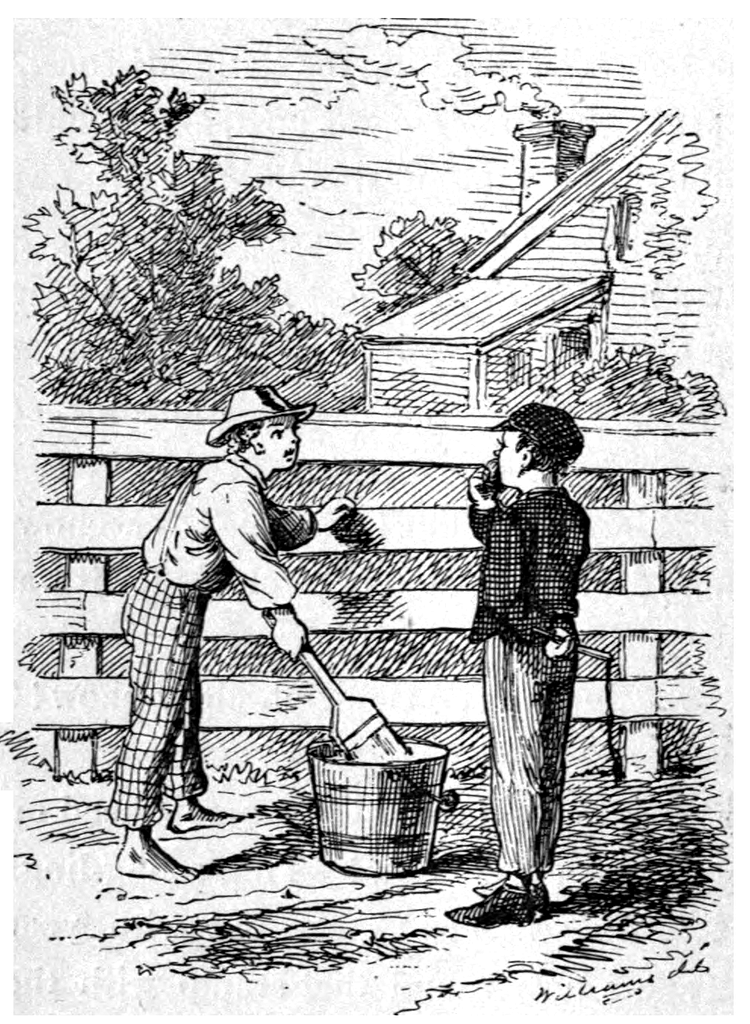
The Adventures of Tom Sawyer is an adventure novel written by Mark Twain and published on June 9th, 1876. The story follows its young, mischievous protagonist, Tom Sawyer, as he grows up in the small town of St. Petersburg, Missouri. Living with his Aunt Polly, Tom moves through the novel guided by his dramatic, restless imagination, which constantly pulls him into adventures that shape his sense of self. Whether he is skipping chores, bending the truth to impress his peers, or even witnessing a murder in a graveyard, Tom never experiences a dull day.
What makes the novel feel lively is the way Tom teeters between creating chaos and stumbling into genuine growth. He is sly enough to turn punishment into a game, yet capable of real courage when it matters most. His friendship with the town outcast, Huckleberry Finn, pulls him into danger but also forces him to confront what kind of person he wants to be…or what kind of person his town expects him to become. By the end of the novel, Tom is not a model citizen; he is still a cunning boy with an expansive imagination. But beneath all that, there is a subtle sense that he is beginning to develop a responsibility he did not have at the start.”
One of the most prominent themes in the novel is the tension between childhood freedom and the expectations of adult society. Throughout the story, Tom is constantly pulled between the imaginative world he wants to live in, full of adventure, play, and self‑made rules, and the more rigid world the adults around him expect him to follow. Twain uses Tom’s mischievous behavior to explore how children push back against adult authority as a way of figuring out who they are and who they want to become. High‑stakes moments, like the graveyard scene, force Tom to confront responsibility, fear, and his own developing sense of morality, highlighting how uneven and unpredictable real growth can be.
Twain’s writing style throughout the novel reinforces this theme through his use of satire and humor. His use of dialect in the characters’ conversations helps establish the setting and gives the story a strong sense of place along the Mississippi River. The episodic structure, where each chapter feels like its own burst of trouble or excitement, mirrors the unpredictable rhythm of childhood. As the tone shifts between serious and playful, Twain can critique adult hypocrisy while still capturing the momentum and freedom of being a carefree kid. This balance in his storytelling makes the novel feel nostalgic for readers while also revealing some of the more honest realities of growing up.
I think The Adventures of Tom Sawyer is considered a classic because it does not present childhood to be something simple-minded, but rather complex and layered. When reading, I found the storyline and imaginative structure to be fulfilling, yet sometimes I felt lost when it comes to the dialect and rhythm. Tom is by no means a likeable character a lot of the time, which makes him a great example of what a young boy is. His flaws and wild imagination are what really drives the novel into what it is. While some of the language is very outdated to what is acceptable now, I can see why some people still appreciate it. In the end, The Adventures of Tom Sawyer is a novel that uniquely mixes satire, childhood experiences, and expectations to successfully tell the story of a young boy navigating the space between childhood and adulthood.